
Science
The Oyster Crisis
Over 85% of global oyster reefs have been lost in the last 150 years. Texas has lost over half of its oyster reefs in 130 years. It has dropped from the second-largest oyster production state to fourth. It’s time to turn the tide.
Oysters are Nature's Infrastructure
Fresh Water Meets the Gulf
A Texas bay stays healthy when rivers reach it. Freshwater inflows set the salinity gradient, deliver nutrients and sediment, and keep the estuary from turning too salty. Likewise, in flood years, tides keep it from becoming too fresh - establishing a good balance for marsh plants, seagrass, crabs, and oysters. Oyster reefs balance the speed and power of these water flows.

Salt Marshes and Wetlands at the Edge
Salt and brackish marshes are the landward half of the bay. They blunt waves, trap sediment, filter runoff, and feed the food web that supports fish and wading birds. Every Texas bay system has lost wetland acreage; a healthy bay is one where those marshes still hold the shoreline instead of converting to open water. Oyster reefs are a living seawall that protects those marshes and wetlands from wave energy and erosion.
A Working Nursery for Fish and Shellfish
About 90 percent of the Gulf’s commercially and recreationally important fish and shellfish spend part of their lives in these bays. In a healthy system, juvenile shrimp, blue crabs, redfish, speckled trout, and flounder find food and cover in seagrass, marsh creeks, open-bay bottom, and oyster reef.
Birds, Crabs, and a Full Food Web
A complete bay feeds more than anglers. Whooping cranes in San Antonio Bay depend on blue crabs, which in turn depend on freshwater inflow. Laguna Madre winters most of the world’s redhead ducks on shoalgrass. Rookeries, tidal flats, and marsh edges also support Roseate Spoonbills, Reddish Egrets, and hundreds of other species along the flyway. These are complex food chains dependent on oyster reefs role in the ecosystem.

Clear Water, Balanced Nutrients, Enough Oxygen
Healthy bay water is not sterile; it is balanced. Nutrients arrive in the right amounts and are balanced by their counterparts, algae do not take over, and dissolved oxygen stays high enough for fish and bottom life. Clearer water also lets sunlight reach the bottom: without that light, seagrass cannot grow. Oyster reefs filter those nutrients and algae, allowing seagrass to flourish.

Living Shorelines, Including Oyster Reefs
Oyster reefs are one piece of the bay’s natural infrastructure, not the whole story. Together with marshes and seagrass, they reduce wave energy, slow some of the highest erosion rates on the U.S. coast, and give structure to an otherwise soft bottom. When that living wall is intact, the marsh behind it has a chance to stay healthy and robust.

Seagrass Meadows on the Bay Floor
Seagrass beds are the underwater pastures of a healthy Texas bay and estuary. They stabilize sediment, store carbon, and shelter young fish and shrimp. They persist where water is clear, salinity is suitable, and the bottom is not repeatedly torn up or buried.
A Bay That Can Keep Renewing Itself
A healthy Texas bay stays connected: tides exchange water with the Gulf, sediment rebuilds marsh, shell remains for the next generation of oysters, and harvest leaves enough habitat for fish, crabs, and birds to abound. Protect the inflows, the water, the grass, the marsh, and the reef, and the system can keep working for generations to come.
Oysters Are Nature’s Infrastructure
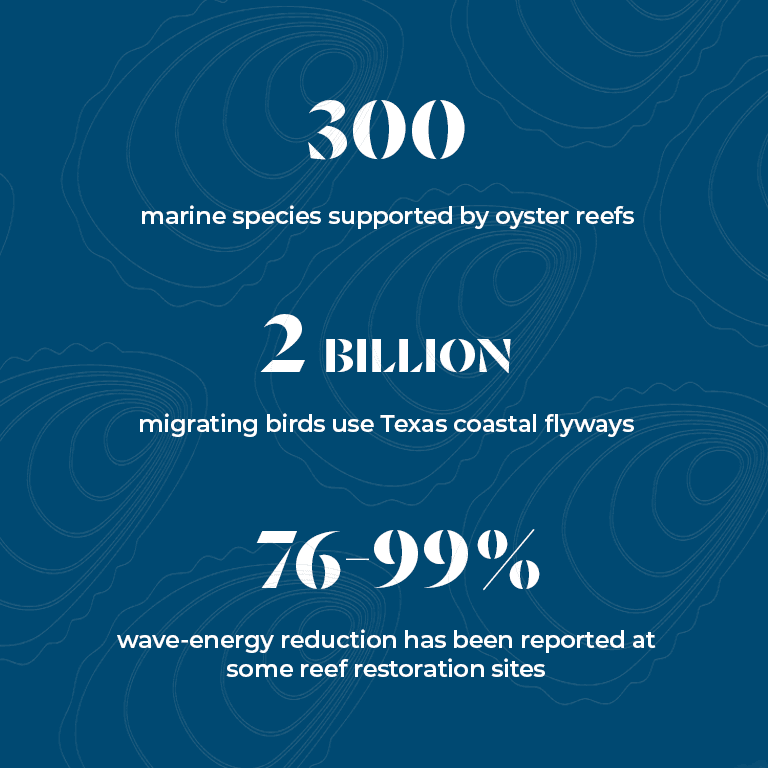
300 Marine Species Supported by Oyster Reefs
Oyster reefs are living infrastructure: they provide a home for marine life, reduce erosion and wave energy, and filter water to create cleaner and healthier bays.
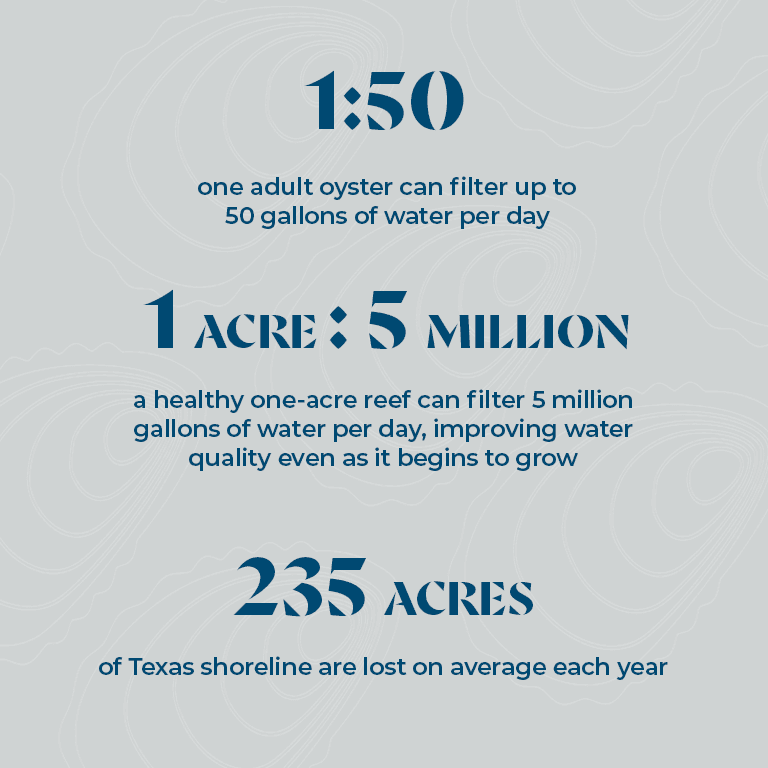
50 Gallons a Day Per Adult Oyster
Texas: The Crisis and Opportunity
Texas once had 88,000 acres of oyster reefs largely used for harvest. Today, only
25,000 harvest acres remain, with total reef acreage estimated at about 40,000 acres.
Historic losses resulted from overharvest, drought, pollution, and the compounding
damage of Hurricanes Ike and Harvey. Texas has fallen from the second-largest oyster-producing state in the nation to fourth. Industry harvest decline is not inevitable. It is the direct result of the continued destruction of the natural resource. But here is what makes Texas different—and what makes this moment so critical.
Chesapeake Bay lost 98% of its oyster biomass before it began serious restoration. Its comeback took four decades of substantial public and private investment. New York
Harbor has its “Billion Oyster” program to bring its oysters back from extinction. The
Apalachicola Bay oyster population completely collapsed in 2020. These are cautionary tales. Texas is not there yet—but the window is narrowing.
Texas Oyster History - Carlos Reef
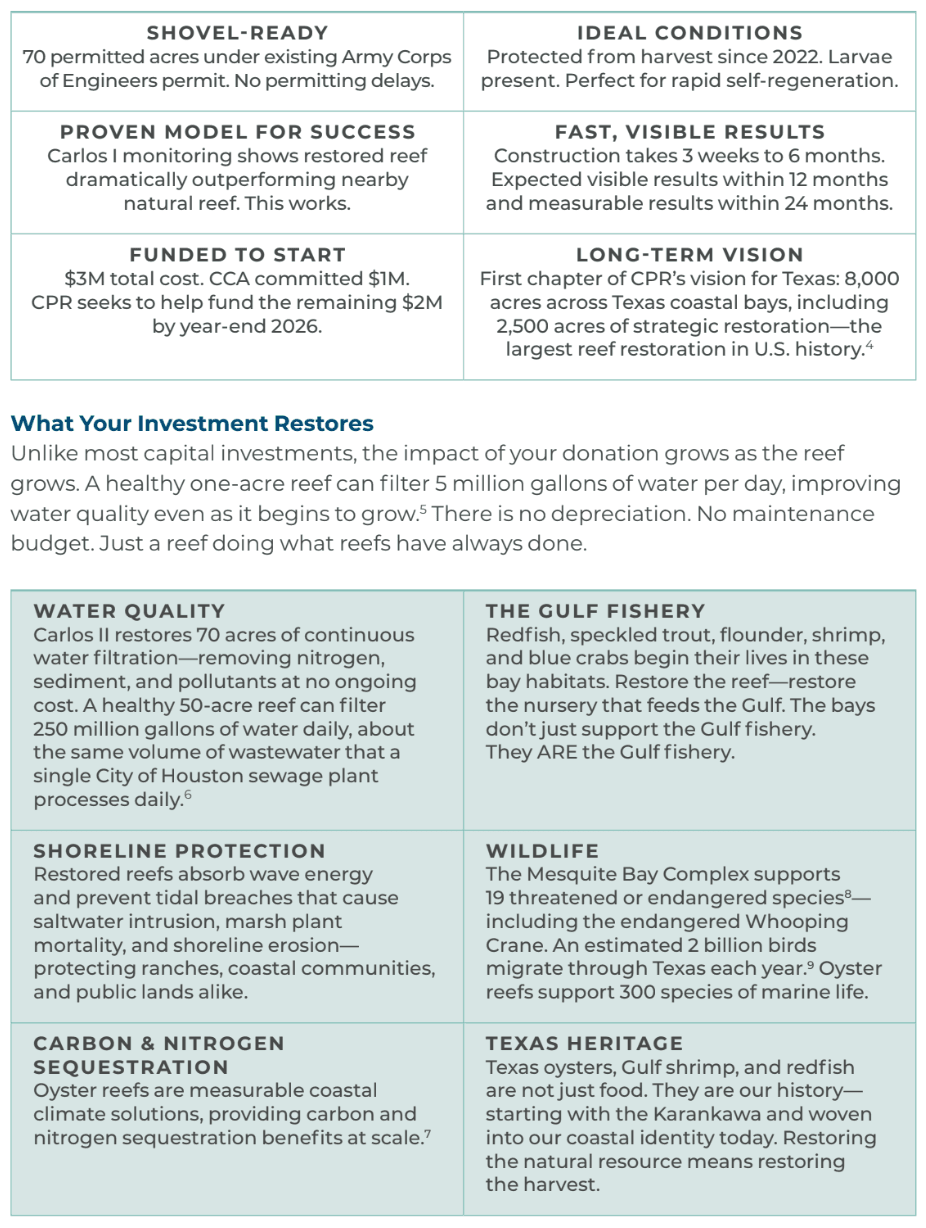
Carlos Reef is the westernmost baffle reef of the 56,688-acre Mesquite Bay Complex and Sanctuary – a protected sanctuary closed to commercial harvest since 2022. As a historic baffle reef, it once managed the area’s water flow, absorbing wave energy, preventing shoreline erosion, and creating the complex habitat on which the entire web of bay life depended. Its loss is severely and negatively impacting the surrounding land, water, habitat, and the entire ecosystem. The adjacent Carlos I project is the proof point for Carlos II’s success. TPWD spent $2.45M to place 13,000 cubic yards of cultch (the shell substrate larvae need to settle and grow) across 70 acres. Post-restoration monitoring shows the restored area dramatically outperforming unrestored segments with 2x–4x comparative growth—dominated by juvenile oysters actively self-regenerating. The science is confirmed. The Army Corps permit for Phase II is in hand.
Great Plains Shelterbelt
Great Plains Shelterbelt project in 1934 after the Dust Bowl planted 220 million trees to slow winds, trap dust, and lessen the evaporation of moisture from the soil. It reached from Canada all the way to Brazos TX.
Oyster reefs are the shelterbelt for our bays. They slow wave action and intensity, reduce erosion, and improve the quality of the water by filtering and turning into tasty protein. They also give vital habitat to our bays’ wildlife; crabs, birds, fish, and more.
Living Infrastructure
Oyster reefs are living infrastructure. Unlike concrete or steel, they are built by life and strengthened by time. When reefs are healthy, oysters grow on one another vertically, forming complex structures that rise from the bay bottom and create habitat for fish, crabs, birds, and other marine life across the coastal food web. The vertical structure of oyster reefs is essential for protecting the ecosystem of Texas bays and estuaries. Low, flattened shell does not provide the same protection or ecological function as a living reef with height, density, and surface area. A restored reef must be more than material placed in the water. It must rebuild structure, function, and resilience before the bay loses more capacity to recover and sustain life.